Pulsed Neutron Neutron (PNN) Tool for Porosity Measurement in Cased Wells
Introduction
Well logging has been used since the 1920s to evaluate reservoir properties such as porosity, saturation, and permeability. Among these, porosity is one of the most critical parameters, as it directly influences reservoir evaluation and production potential.
While many porosity measurement methods exist for openhole conditions, options are limited in cased wells. This is especially relevant for older fields where historical porosity data is often missing.
The Pulsed Neutron Neutron (PNN) tool, primarily designed for reservoir monitoring and saturation evaluation, can also provide valuable porosity information when properly modeled and calibrated.
PNN Tool and Measurement Principle
The PNN tool operates as a neutron–neutron logging system equipped with:
- an electrical neutron generator
- two neutron detectors
Neutrons emitted into the formation interact with surrounding materials and lose energy through collisions. The rate of energy loss depends mainly on hydrogen content, making neutron tools sensitive to the Hydrogen Index (HI).
👉 Since hydrogen is mainly present in formation fluids (water, oil), the measurement indirectly reflects formation porosity.
Neutron Porosity Measurement Theory
Neutron logging is based on the principle that:
- Neutrons slow down most effectively when colliding with hydrogen nuclei
- The thermalization process (slowing to thermal energy) depends on hydrogen concentration
In clean formations:
- Hydrogen → fluid-filled pores → porosity indicator
However, corrections are needed for:
- shale content (bound water, OH groups)
- mineral effects
Specific Advantages of the PNN Tool
The PNN tool introduces key improvements compared to conventional neutron tools:
1. Time-Channel Measurement
- Measures thermal neutrons in 60 time channels (36 µs each)
- Allows detailed analysis of neutron decay behavior
2. Ratio Imaging Technique
- Generates ratio images from time-channel data
- Enables extraction of optimized curves for interpretation
3. Optimal Porosity Zone Detection
- Best porosity results are obtained from channels 5–9
- These correspond to the thermalization zone, closest to:
- true porosity response
- epithermal neutron behavior
Porosity Evaluation Using PNN
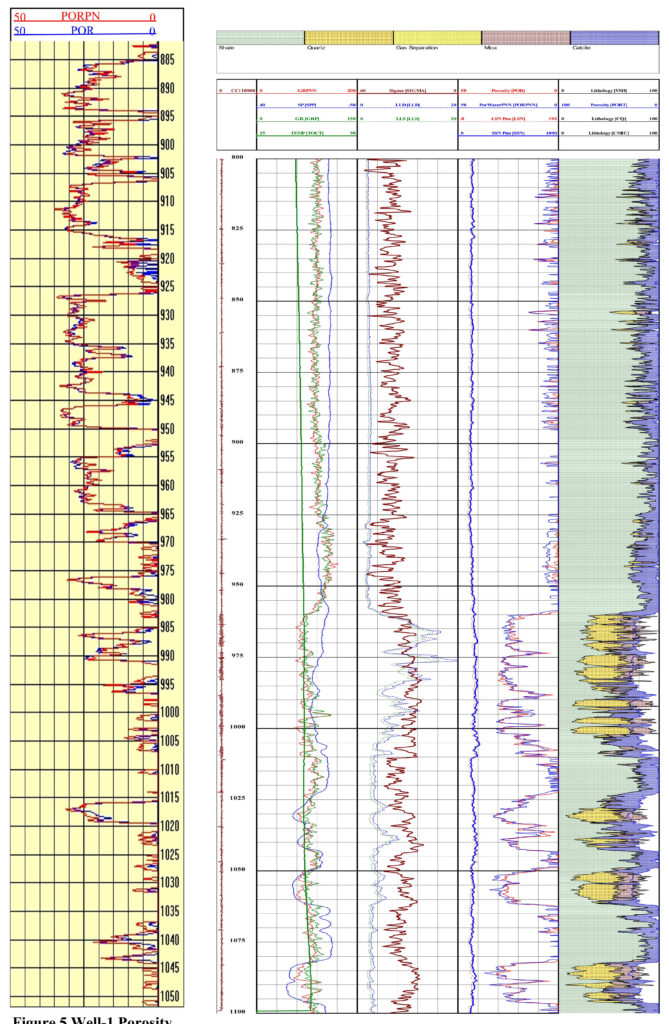
Although not originally designed for porosity, the PNN tool becomes highly effective when:
- calibrated with openhole neutron porosity data
- used to build correlation models
Workflow:
Extract ratio curves (e.g., channels 7–9) Correlate with openhole neutron logs Build porosity model Apply model to wells without porosity data
Field Applications
The PNN-based porosity approach is especially useful for:
- Old wells without reliable porosity logs
- Cased hole environments where openhole tools cannot be used
- High salinity or complex formations
- Reservoir monitoring and re-evaluation of existing fields
Key Benefits
Provides porosity estimation in cased wells Reduces influence of:
- high neutron capture cross-section fluids
- formation minerals
Improves:
- reservoir characterization
- saturation analysis
- field development decisions
Conclusion
The Pulsed Neutron Neutron (PNN) tool extends beyond its primary role in saturation logging by offering a reliable alternative for porosity evaluation, particularly in challenging environments.
By focusing on measurements near the thermalization zone and using ratio-based processing, the PNN method minimizes environmental effects and delivers accurate results.
👉 This makes the PNN tool a powerful solution for:
- legacy fields
- cased hole analysis
- advanced reservoir evaluation